

If you have been told you have cervical insufficiency, it is natural to want to understand what it means for the rest of your pregnancy.
Here is some reassurance: cervical insufficiency is not something you have caused, and it is not a verdict on your pregnancy. It is a recognised and manageable condition, and your team monitors it closely so they can act early if needed. With monitoring and a clear plan in place, most women in this situation go on to have a healthy baby.
This article explains what cervical insufficiency is, how it is diagnosed, the scan used to check your cervix, and what a diagnosis means for the rest of your pregnancy.
Table of contents
- What is cervical insufficiency?
- How is cervical insufficiency diagnosed?
- The scan used to check your cervix
- Is cervical insufficiency the same as a short cervix?
- What cervical insufficiency means for the rest of your pregnancy
- Book a cervical assessment at QUFW
- Frequently asked questions
What is cervical insufficiency?
The cervix is the lower part of the uterus, the passage that connects the uterus to the vagina. For most of your pregnancy, it is meant to stay firm and closed, holding everything safely in place until your body is ready for labour.
Cervical insufficiency describes a cervix that begins to open too early, usually during the second trimester, and often without the pain or contractions you would expect with labour. It can happen quietly and can lead to a very early birth or a mid-trimester loss.
Cervical insufficiency is more common in patients who have had previous cervical surgery or biopsy (such as a cone biopsy or a LLETZ procedure), prior early pregnancy loss or previous cervical insufficiency.
How is cervical insufficiency diagnosed?
No single test diagnoses cervical insufficiency on its own. It is largely a clinical diagnosis, meaning your obstetrician puts together several pieces of information rather than relying on a single result.
Your obstetric and gynaecological history is one of the most important clues. A previous painless loss in the second trimester, or a very early birth, is the classic situation that raises the possibility of cervical insufficiency. In a current pregnancy, it may also be suspected if an examination finds that the cervix has already begun to open, or if changes are seen when your cervix is assessed on ultrasound. Where your history or risk factors suggest an increased risk, your team will usually keep a close eye on your cervix through the pregnancy so that any change is picked up early.
When is the cervix checked?
The cervix is checked and measured routinely at all pregnancy scans. Patients will be asked to present to their pregnancy scans with a comfortably full bladder. A full bladder provides an acoustic window that allows your sonographer to adequately visualise the cervix. A cervical length measuring less than 35 mm on transabdominal ultrasound will prompt your sonographer to offer a transvaginal ultrasound for a more detailed assessment. This will only be performed with your consent. A transvaginal ultrasound is the preferred and most accurate method of measuring the cervix at the morphology scan (20-22 weeks). The examination is performed with an empty bladder and minimal pressure from the transducer. A transvaginal scan lasts no more than a minute or two. Some women feel apprehensive about having a transvaginal scan in pregnancy. This technique is safe in pregnancy, and most patients find it involves little or no discomfort. When there is a reason to monitor your cervix, these scans are usually repeated at different stages of pregnancy. This is exactly the kind of careful, specialist assessment where subspecialist experience and high-end equipment make a real difference.
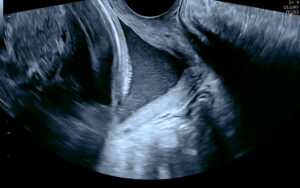
Cervical insufficiency on ultrasound
Is cervical insufficiency the same as a short cervix?
These two terms are closely related, but not the same.
It is quite normal for the cervix to shorten slightly, but remain closed, toward the end of a pregnancy. The cervix is “short” when it measures less than 25 mm on transvaginal ultrasound. The cervix can remain short and closed until the onset of labour. A short cervix is more concerning the earlier it presents in pregnancy. For most patients, it is an isolated finding that is simply monitored with ultrasound at regular intervals. Your obstetrician will interpret your situation in the context of your full history and may prescribe progesterone.
A short cervix can progress to cervical insufficiency in some cases. Cervical insufficiency is when the cervix opens prematurely, allowing the amniotic membrane to protrude into the opening. In these cases, patients are more likely to experience premature rupture of membranes (PPROM), leading to premature delivery. These patients are more at risk of infection and early pregnancy loss.
What cervical insufficiency means for the rest of your pregnancy
The good news is that cervical insufficiency is actively managed, and you will not be navigating it alone.
In practice, your care will usually include closer monitoring of your cervix during the relevant weeks of pregnancy, so that any changes are picked up early. Alongside that, there are two main treatments. One option is a cervical cerclage: a stitch placed in the cervix to give it extra support. This may be recommended in certain situations, particularly where there is a history of a previous early loss or preterm birth. Another option is vaginal progesterone, usually taken nightly. There is good evidence that supports the use of progesterone to help reduce the risk of preterm birth in people with a short cervix by supporting uterine relaxation and limiting inflammatory changes that can contribute to cervical shortening. Cervical pessaries have been used to support a short or insufficient cervix, but evidence of the benefit is inconsistent, so they are not routinely recommended for preventing preterm birth. Vaginal progesterone and, in selected cases, cervical cerclage have stronger guideline support. Your obstetrician will advise you on the most appropriate approach and intervention based on your history and your individual circumstances.
Your team may also discuss whether to adjust certain activities, and this is a conversation worth having with them directly rather than relying on general advice. The most useful thing you can do is keep the lines of communication open with your team and ask them anything that is worrying you. Closer monitoring is not a sign that something is already wrong; it is a deliberate way of staying a step ahead.
Book a cervical assessment at QUFW
At QUFW, our consultants are subspecialist obstetricians and gynaecologists with extensive experience in obstetric ultrasound, supported by highly trained sonographers. If your history means your cervix needs close monitoring, we can provide the detailed transvaginal assessment needed to evaluate it accurately and support you and your care team with a clear plan forward.
If you would like to arrange an assessment, click here to book an appointment. We are here for you.
Frequently asked questions
Is cervical insufficiency the same as a short cervix?
Not quite. A short cervix is a measurement found on a scan and a risk marker. Cervical insufficiency is a diagnosis describing a cervix that opens too early, usually painlessly, in the second trimester. A short cervix can point toward that risk, but the two are not the same thing.
How is cervical insufficiency diagnosed?
Mainly from your history. Particularly a previous painless second-trimester loss or very early birth. This history, together with a clinical examination and a transvaginal ultrasound of the cervix, can help your care team make a diagnosis. No single test diagnoses it on its own; your obstetrician considers the full picture.
Can you have a successful pregnancy with cervical insufficiency?
Yes. With monitoring and a clear plan. This may include a cervical stitch or progesterone, and most women go on to have a healthy baby. Cervical insufficiency increases the chance of an early birth, but it does not determine the outcome.
Does cervical insufficiency have symptoms?
Often not, which is why the cervix is checked on a scan rather than by waiting for signs. Some women may notice pelvic pressure, backache, or a change in discharge, but these are non-specific and cannot be relied on. If you have any bleeding, fluid loss, or regular tightening, contact your care team promptly.
How is cervical insufficiency treated?
The two main options are a cervical stitch (cerclage) and vaginal progesterone, chosen according to your circumstances and history, alongside closer monitoring of your cervix. Your obstetrician will recommend the approach best suited to you.
Sources: This article draws on guidance from the Royal Australian and New Zealand College of Obstetricians and Gynaecologists (RANZCOG). For more, see the RANZCOG resource hub at ranzcog.edu.au/resource-hub.
Content Disclaimer
The information provided on this website is for educational and informational purposes only. It is not intended as a substitute for professional medical advice, diagnosis, or treatment. Always seek the advice of your obstetric doctor or other qualified provider with any questions you may have about a medical condition or treatment, and before starting a new healthcare regimen.
The content on this website is not intended to be a comprehensive source of information on any particular topic and should not be relied upon as such. The authors and publishers of this website are not liable for any damages or injury resulting from the use or misuse of the information provided on this website.
0 Comments