
For women living in remote and regional Queensland, the path to answers about pelvic pain and gynaecological issues looks very different from the one of their city counterparts. It is longer, more expensive and often means stacking a month’s worth of appointments into a single trip because coming back next week is not an option.
We recently asked one of our patients, a young woman from Western Queensland about navigating her pain and the health system while living on a farm. Her story is not unusual for women living hours from a major centre and we are grateful she was willing to share it to shine a light on the challenges facing women living in remote areas of Australia.

Lucinda at work on a cattle property in the Gulf of Carpentaria
Table of contents
- Life on the land, and the pain that started at eleven
- What it takes to see a specialist from 660km away
- The real cost of travelling for care
- Feeling heard, but not always understood
- The scan that shaped what comes next
- To other women in remote and regional Queensland
- Book an endometriosis-informed ultrasound at QUFW
Life on the land, and the pain that started at eleven
Home for Lucinda is Western Queensland, roughly 660 kilometres, or seven hours drive from Toowoomba. Until recently she was working as a station hand: cattle work, long days on horseback, riding motorbikes across her property.
Alongside a physically demanding job, Lucinda has lived with pain since she was eleven.
“Before my first period I remember experiencing really bad period cramps on and off and I didn’t know what it was at the time as I was 11 and hadn’t had my period before. The pain eventually got really bad, then I got my period and realised that was what the pain was.”
By thirteen or fourteen she was on the pill, prescribed to manage heavy bleeding and cramping her mother sensed was heavier than most girls her age described. She stayed on it for close to a decade because this had become the status quo for managing intense pelvic pain in women.
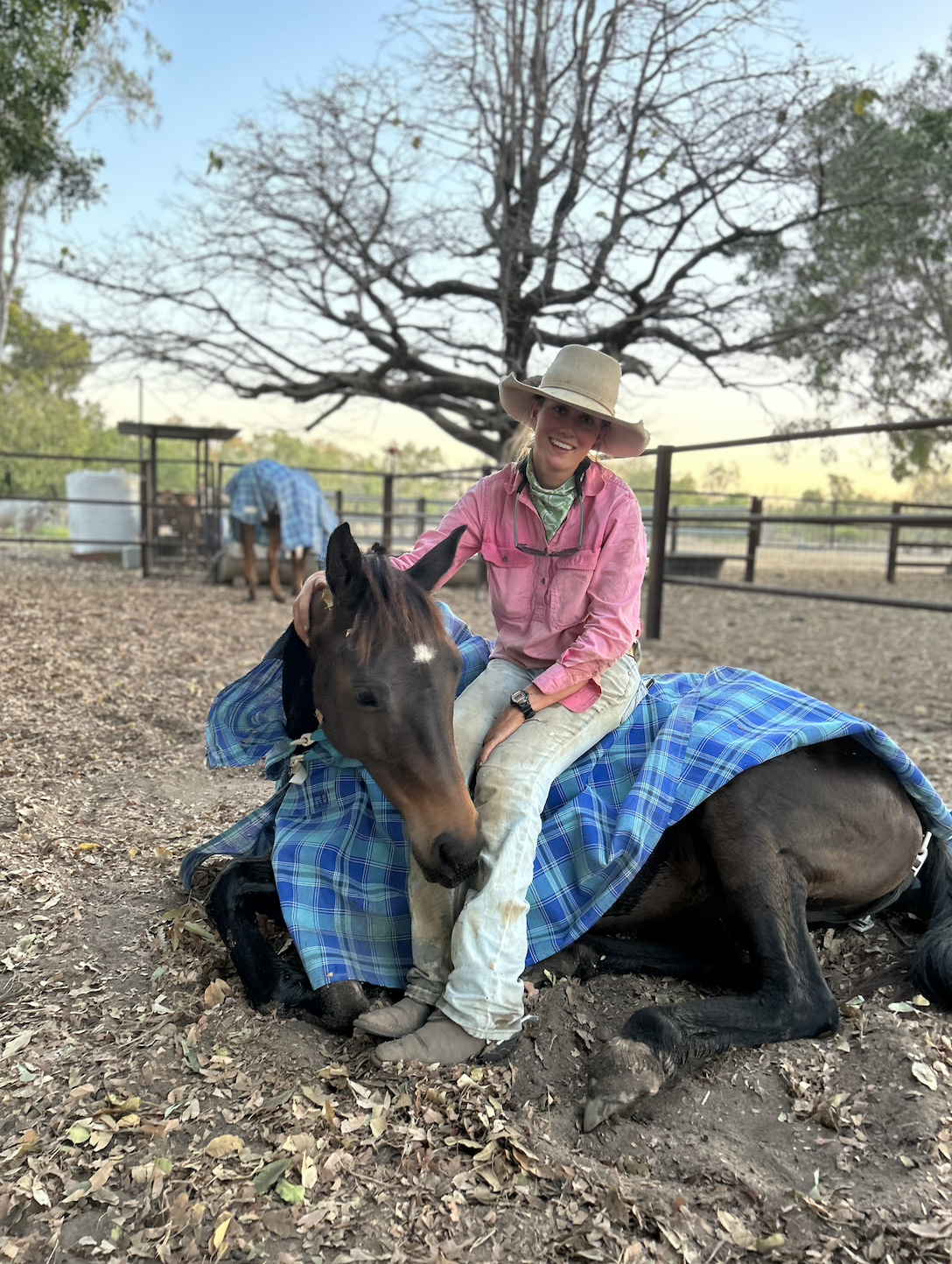
Lucinda at work on a cattle property
What it takes to see a specialist from 660km away
Two years ago the picture changed. She came off the pill she had been on since her early teens, and within months the pain intensified and she was back to her GP to get to the bottom of her symptoms.
What followed is the pattern many women with suspected endometriosis will recognise. Her GP raised endometriosis as a possibility, and from there the investigations added up quickly with scans, imaging, blood work, referrals to specialists and allied health practitioners across women’s health, gastroenterology and pelvic care. Each result narrowed the picture a little, but nothing definitive emerged. Along the way she was referred to QUFW for a specialised endometriosis ultrasound.
Each of those appointments posed a logistical challenge:
“I try to line up a bunch of appointments within a week or two (or four, which I had to do recently). Luckily for me I am able to stay with family in Toowoomba, because I wouldn’t be able to afford accommodation for all that time.”
Telehealth, she says, has its place, particularly for follow-ups where there is nothing physical to examine. But scans, examinations, internal assessments, and pelvic floor work cannot happen through a video link. And even for the appointments telehealth can cover, she has found that describing pelvic pain to a practitioner over a screen is harder for both sides versus being in the same room.
The real cost of travelling for care
The financial reality is difficult to overstate. Individual appointments regularly cost more than $100, some more than $200, and specialised scans can run to $500 or more. Over the past two years she has lost track of the total. Last year she reached the Medicare Safety Net threshold, a service she is grateful for, but one that only exists because the underlying spend is so high.
Beyond direct costs, the career impact has been substantial. Station work is physically demanding, and with pelvic and back pain proving difficult to treat, she had to pause this type of work.
“I have not been working for the last year or so as the work I was doing was very physically demanding and my body wasn’t keeping up. Luckily, I have been able to live with my parents, but I have had a period of 18 months where I haven’t had a steady income while trying to find a new career path that will suit my situation.”
For women without the safety nets of family, the same clinical journey would be financially unreachable.
Feeling heard, but not always understood
Lucinda said she’s “been very lucky to have a supportive medical team” and doesn’t feel like she’s been dismissed by anyone and they are mostly very quick to reinforce that her pain is real.
What she has felt is misunderstood, and deflated by the structural realities of the system.
“There are so many nuanced areas of the wider women’s health and pelvic pain field, and I have found it difficult to find practitioners that have in-depth knowledge in some of these areas. I think most of the trouble I’ve had with practitioners is not a fault of their own but is simply the fact that they are so pressured for time and where I’ve been able to get an hour-long appointment with certain practitioners, it takes almost the whole hour just to explain my pelvic pain and symptoms and the impact that its having on my life which is such a hard thing to judge when it’s about your own situation. Then you have to wait another month or two for a follow up to actually get started on an action plan. It has left me feeling pretty deflated and defeated at times.”
The scan that shaped what comes next
Recently Lucinda had a specialised endometriosis ultrasound at QUFW. Aside from her pain, nothing conclusive was found. This result is worth explaining, because it is one of the more misunderstood outcomes in this field.
An endometriosis-informed ultrasound is designed to look for deep infiltrating endometriosis and its structural signs: nodules, adhesions, endometriomas, sliding sign abnormalities, involvement of the bowel, bladder, uterosacral ligaments and pouch of Douglas. It is a much more detailed assessment than a standard pelvic ultrasound. When it does not identify these findings, it does not mean pain is not real, or that endometriosis is not present. Superficial disease in particular can sit below the resolution of any imaging modality. A thorough scan can sometimes be the cause for the next step and further investigation.
For Lucinda, the next step is a laparoscopy which is currently the only way to definitively diagnose or exclude endometriosis, and for many women this is the point where years of investigation finally gets some answers.
To other women in remote and regional Queensland
There are many women who are facing similar challenges to Lucinda, due to the complex nature of particular gynaecological issues compounded by vast geographical distances from medical care.
Keep going, find the practitioners who take the time and use resources that make sense to you.
At QUFW, we see women who have travelled across Queensland for a scan they cannot get closer to home. We know what that trip costs and it shapes how we approach every appointment.
Book an endometriosis-informed ultrasound at QUFW
If you are experiencing pelvic pain, or your treating team has raised endometriosis as a possibility, a specialised endometriosis ultrasound at QUFW is a considered next step. Our sonographers and consultants are experienced in deep infiltrating endometriosis assessment, and we work closely with your referring GP or gynaecologist to make sure the findings translate into a clear plan.
For women travelling from regional and remote Queensland, we can coordinate appointments to make the most of your time with us and you will be able to access consultations with our team of Doctors via Zoom.
Click here to contact us and book an appointment.
Content Disclaimer
The information provided on this website is for educational and informational purposes only. It is not intended as a substitute for professional medical advice, diagnosis, or treatment. Always seek the advice of your obstetric doctor or other qualified provider with any questions you may have regarding a medical condition or treatment and before undertaking a new healthcare regimen.
The content on this website is not intended to be a comprehensive source of information on any particular topic and should not be relied upon as such. The authors and publishers of this website are not liable for any damages or injury resulting from the use or misuse of the information provided on this website.
This story is shared with the patient’s permission. Some responses have been lightly edited for length and clarity.
0 Comments